Biathlon Rules, Scoring & Competition Format — A Complete Guide
The basics
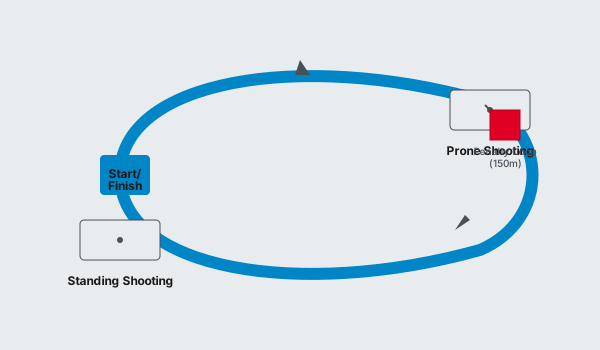
In sprint events, each missed target adds a 150-meter penalty loop — roughly 25 extra seconds. In individual events, each miss adds one minute to the total time. Fastest corrected time wins.
The Unique Dual Challenge: How Biathlon Rules Work at the Winter Olympics
Biathlon fuses two wildly different athletic demands — the aerobic fury of cross-country skiing and the precision calm of rifle marksmanship — into a single race. Governed by the International Biathlon Union (IBU), the sport’s rulebook must account for both the ski track and the shooting range, creating a competition unlike any other at the Winter Games.
Event Formats
The Olympic biathlon program includes five individual events for each gender plus one mixed event:
- Individual — the original format. Men ski 20 km, women 15 km, with four shooting stages (two prone, two standing). Each missed target adds a one-minute penalty to the skier’s time.
- Sprint — a shorter race (10 km men / 7.5 km women) with two shooting stages (one prone, one standing). Each miss means a 150-meter penalty loop.
- Pursuit — athletes start in the order and with the time gaps from the sprint. Same distance as the sprint, with four shooting stages. The first to cross the finish line wins.
- Mass Start — 30 athletes start together. Men ski 15 km, women 12.5 km, with four shooting stages.
- Relay — teams of four each ski three legs with two shooting stages per leg. Athletes get three spare rounds per stage; any targets still standing after eight shots require penalty loops.
- Mixed Relay — two women and two men per team, each skiing one shorter leg.
The Shooting Range
Athletes shoot at five metal targets from 50 meters away using a .22 caliber rifle they carry on their backs throughout the race. There are two shooting positions:
- Prone (lying down) — target diameter is 45 mm (about the size of a golf ball).
- Standing — target diameter is 115 mm (roughly a CD), accounting for the greater difficulty of shooting while standing and out of breath.
Heart rates typically exceed 160 beats per minute when athletes arrive at the range. Slowing their breathing enough to shoot accurately while competitors ski past is one of biathlon’s great tactical challenges. At Beijing 2022, Johannes Thingnes Bø of Norway won the 20 km individual with just one miss out of 20 shots, finishing in 48:43.4 — illustrating how a single miss can cost roughly a minute.
Penalty System
The penalty structure varies by event and is central to biathlon strategy:
- Individual race: each missed target = +1 minute added to total time. No physical penalty loop.
- Sprint, pursuit, mass start: each miss = one 150-meter penalty loop (takes roughly 20–25 seconds to ski).
- Relay: athletes have three spare rounds per shooting stage (loaded manually, one at a time). If targets remain after all eight shots, each remaining target means a penalty loop.
This penalty structure makes the individual race unique: a fast skier who misses three times (three added minutes) will almost certainly lose to a slightly slower skier who shoots clean.
Course and Equipment
Biathlon courses use the same FIS-certified cross-country tracks groomed for classic and skate techniques, though biathlon races are exclusively skate-style (free technique). The course must include significant climbing and descending sections, with the shooting range typically located in the stadium area.
The rifle must weigh at least 3.5 kg and must not be semi-automatic or automatic — each shot is manually chambered with a bolt action. Athletes carry the rifle in a special harness on their back while skiing.
Olympic Quotas and Team Size
Each nation can send a maximum of six biathletes per gender. Not every country fills that quota; spots are earned through IBU rankings and continental allocations. The host nation receives a minimum guarantee of one spot per gender.
Wind and Weather
Biathlon shooting is outdoors and unsheltered, making wind a genuine competitive factor. A sudden gust can push a bullet just enough to miss the 45 mm prone target. Race officials can halt a competition if wind conditions become dangerously variable, though this is rare. Athletes and coaches monitor wind flags at the range and adjust their aim accordingly — a skill that separates the great from the elite.